Why work is a special listening situation
Work asks a lot of your hearing. Meetings jump between speakers, video calls compress voices, open-plan offices mix conversations with keyboards and air conditioning, and many English speakers in Israel spend the day switching between English and Hebrew. Listening in a second language takes more effort, and that effort grows when hearing is reduced. By the end of the day, many people are simply tired.
The good news is that most of these situations can be planned for. The first step is to describe your working day clearly before the fitting, not after.
Meetings around a table
- Sit where you can see most faces, ideally with your back to the window so faces are not in shadow.
- Ask for one speaker at a time; it helps everyone, not only you.
- A remote microphone placed on the table or clipped on the main speaker can bring that voice closer. Philips describes the HearLink AudioClip as a remote microphone that can be clipped on another person, and Oticon describes ConnectClip as including a remote microphone function.
Video and phone calls
Many hearing aids can stream calls directly from a phone, and some from a computer. Compatibility depends on the hearing aid, the phone or computer and their software. For Android phones and computers without LE Audio, Philips lists the Easy LE Adapter, a USB-C adapter for LE Audio-compatible hearing aids such as HearLink. Turn on captions in your video-call software as a back-up; they help when a voice is unclear. More in hearing aids and phone calls and phone accessibility features.
Open-plan noise
No hearing aid removes the noise of a busy office, but settings and programmes can be adjusted for it during follow-up visits. Tell us which situations are hardest: the desk next to the kitchen, the corridor conversation, the lunch table. Practical tips are in hearing aids in noisy places. The technology level of the hearing aid also plays a part; see hearing aid technology levels.
Telling colleagues: your choice
Whether to tell colleagues is entirely up to you. Some people find a short, practical sentence helps: “I hear better if I can see your face” or “please tell me if I’ve missed something.” Others prefer to keep it private. Either way, small changes, such as written meeting summaries and a quieter room for important calls, tend to help the whole team.
Charging through a long day
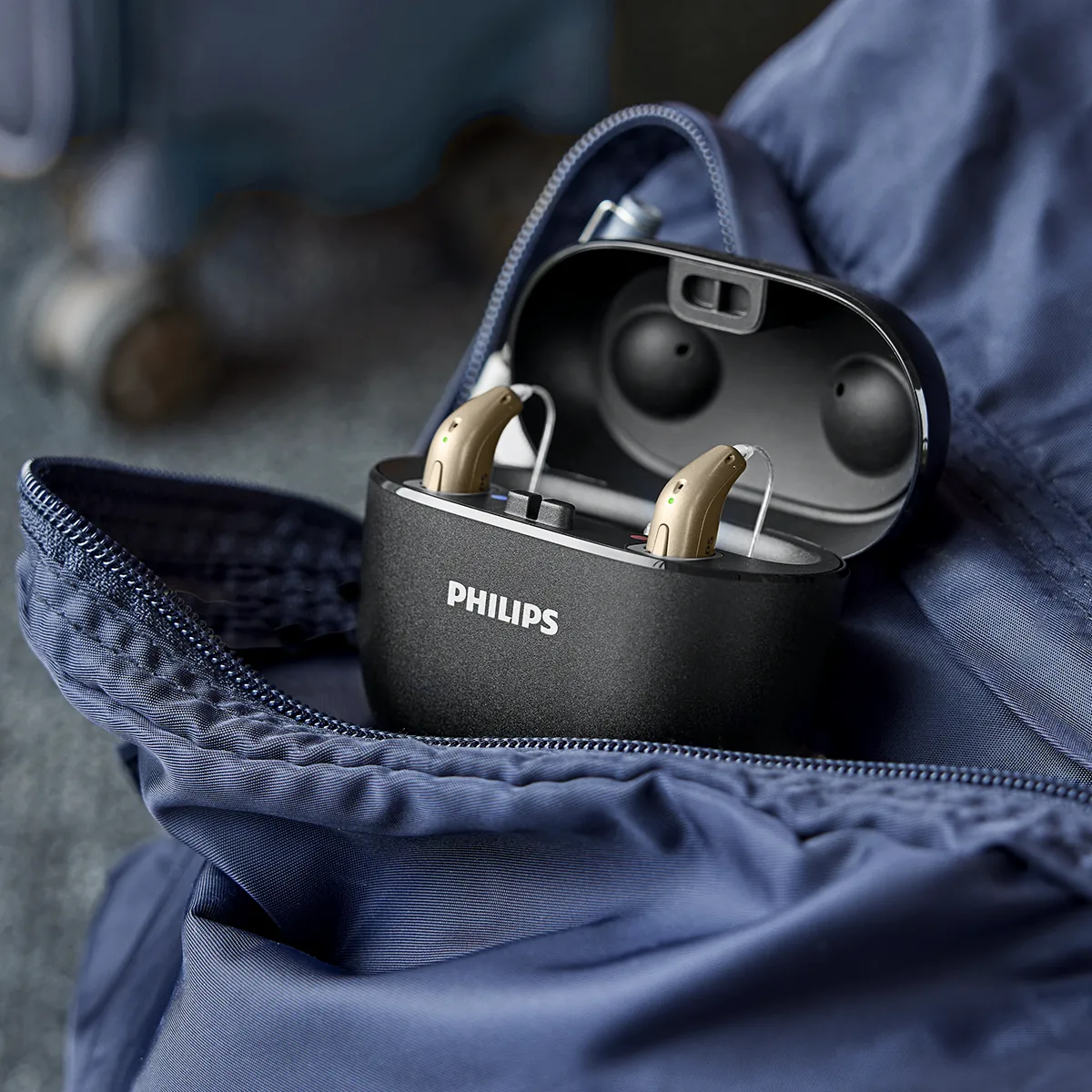
Long days, late meetings and travel between sites make charging a practical question. Ask which chargers exist for the model you are considering. Philips lists a portable Charger Plus with a built-in power bank for HearLink 50 styles; Oticon lists a portable SmartCharger for some styles. See rechargeable hearing aids.
Noisy workplaces
If your work is noisy, such as a factory, a workshop, a building site or sound work at events, protecting the hearing you have matters as well. NIDCD describes noise-induced hearing loss as preventable. Read protecting your hearing from noise, and ask your employer’s safety officer about the requirements in your workplace. G-Sound makes custom earplugs to measure; see custom noise earplugs.
Arranging an appointment around work
G-Sound arranges hearing tests, demonstrations and fittings by appointment, at the client’s home, at work or in another suitable setting, depending on the need. A fitting at work has a practical advantage: settings can be checked in the room where the difficulty actually happens. Read about fitting at home, or get in touch to discuss your situation.
Sources
- Philips HearLink AudioClip — Philips Hearing Solutions — accessed 22 October 2026
- Easy LE Adapter — Philips Hearing Solutions — accessed 22 October 2026
- ConnectClip — Oticon — accessed 22 October 2026
- Noise-Induced Hearing Loss — NIDCD — accessed 22 October 2026
Updated 22 October 2026 · Written by the G-Sound editorial team. General information only; it does not replace a hearing assessment or medical advice.
Frequently asked questions
Can hearing aids connect to my work computer?
Some can, directly or through an adapter. It depends on the hearing aid, the computer and their software, so it is checked for your exact devices.
What helps most in meetings?
Seeing faces, one speaker at a time, and sometimes a remote microphone placed on the table or clipped on the main speaker.
Do I have to tell my colleagues?
No. It is entirely your choice. Some people find a short, practical explanation helps; others keep it private.
Can the appointment take place at my workplace?
G-Sound arranges appointments at the client’s home, at work or in another suitable setting, depending on the need.
Will hearing aids remove open-plan office noise?
No hearing aid removes the noise of a busy office, but settings and programmes can be adjusted for it during follow-up visits.