What a technology level is
Manufacturers often offer the same hearing-aid family at several levels. The devices usually share the same shape, the same charging or battery option and the same colours. The difference is in the software and sound processing: how the hearing aid handles a restaurant, a family dinner or a meeting with several people talking.
Names and numbering differ between manufacturers and between generations, so comparing level numbers across brands tells you very little. A more useful question is: what does this hearing aid do when the environment becomes difficult, and what do I need it to do?
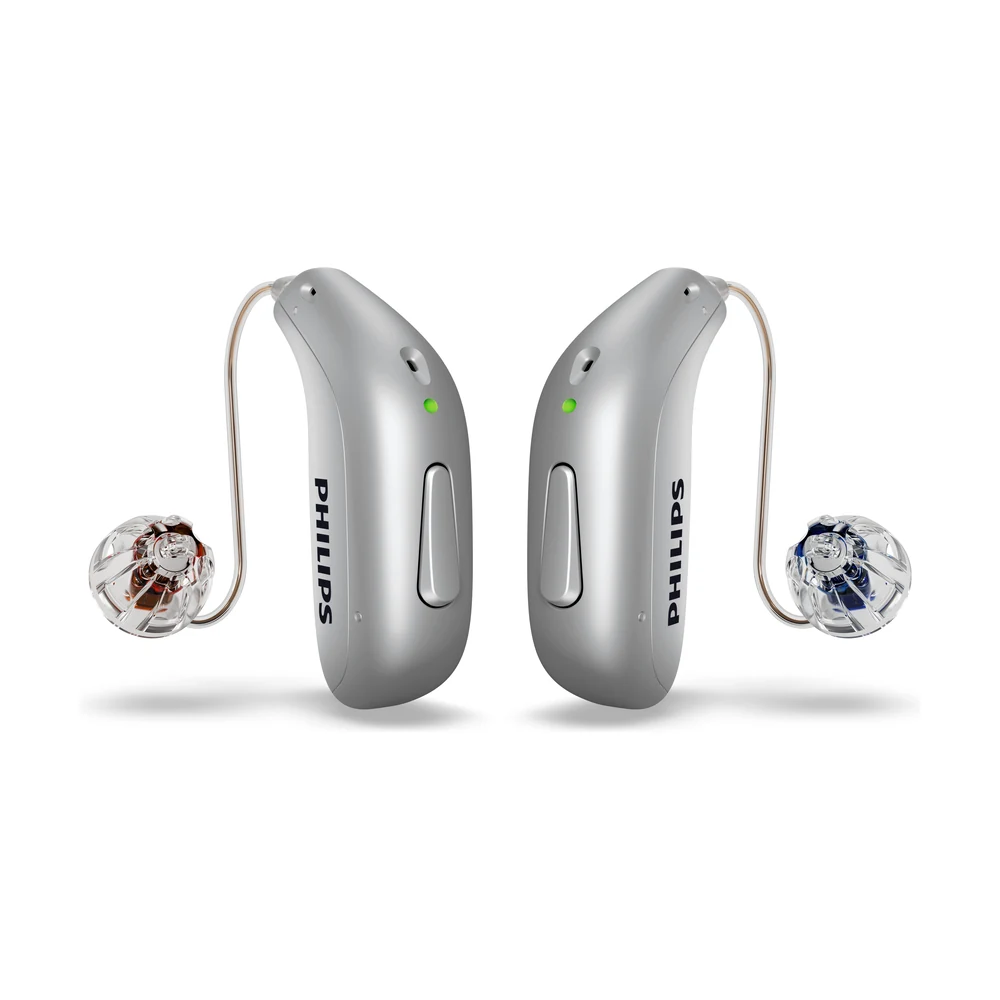
An example: Philips HearLink 9050, 7050, 5050 and 3050
Philips documents its HearLink 50 miniRITE and miniBTE R styles at four levels: 9050, 7050, 5050 and 3050. In the way G-Sound presents the series, 9050 is the highest of the four, 7050 the advanced level, 5050 the mid level and 3050 the entry level. All four share the same family and styles; the right level is a conversation to have with your test results in hand. See Philips HearLink hearing aids in Israel.
Oticon also offers families at more than one level. The details differ by family and generation, so we explain them for the specific model you are considering; see Oticon hearing aids.
Choose by your week, not by the number
Think back over the last week and write down where you were and where hearing was hard. If most of your time is at home, in conversation with one or two people and in front of the television, a basic or mid level may cover most of what you need. If you work in a team, take part in meetings, go to restaurants, family events, lectures or synagogue, the difference between levels is more likely to matter.
The pace of change matters too. Someone who moves through a quiet office, a drive, a phone call and a social evening in one day may value a hearing aid that adapts by itself. Someone who spends most of the day in one place may need less of that.
What usually does not change between levels
A higher level does not replace a good fitting. At every level the hearing aid has to be programmed to your hearing test results, sit correctly in the ear and be adjusted during the first weeks. A top-level hearing aid that is poorly fitted can disappoint more than a lower level that is fitted well. Follow-up is explained in follow-up and adjustments.
The basic limits also stay the same. Hearing aids do not restore normal hearing, and in very loud places every hearing aid will struggle. Phone and TV connectivity is a separate subject: sometimes it is the same at every level of a family, sometimes not, so check it for the exact model. See Bluetooth hearing aids.
Hear it, don’t just read it
A specification sheet describes features in general terms. A demonstration shows how they sound to you. Ask to hear the hearing aid in situations close to your life: speech with background noise, someone talking from the side, the television at a volume that suits the rest of the household. G-Sound arranges demonstrations by appointment, at the client’s home, at work or in another suitable setting, depending on the need.
Questions to ask about any level you are offered
- In which of the situations I listed should this level help more than the one below it?
- What exactly is different between the levels: automatic processing, programmes, app control or connectivity?
- Can I hear two levels one after the other in the same conditions?
- Are the style, charging and connectivity the same at every level shown to me?
For the broader picture of styles, read hearing aid types explained.
Sources
- Philips HearLink 50 miniRITE — Philips Hearing Solutions — accessed 22 October 2026
- Philips HearLink 50 miniBTE R — Philips Hearing Solutions — accessed 22 October 2026
- Hearing Aids — NIDCD — accessed 22 October 2026
Updated 22 October 2026 · Written by the G-Sound editorial team. General information only; it does not replace a hearing assessment or medical advice.
Frequently asked questions
Is the highest technology level right for everyone?
Not necessarily. If most of your day is spent in quiet settings, the difference may not be noticeable. The choice follows your listening environments and what you hear in a demonstration.
Do hearing aids at different levels look different?
Often they look almost identical from the outside, because the difference is in the software and sound processing. Details are checked for the specific model.
What are Philips HearLink 9050, 7050, 5050 and 3050?
Four technology levels of the Philips HearLink 50 family. 9050 is the highest level and 3050 the entry level.
How can I tell whether I would notice the difference?
Hear two levels one after the other, in the same conditions and in a situation close to your day, such as conversation with background noise.
Does a higher level mean fewer follow-up visits?
No. At every level the hearing aid is programmed to your test results, and adjustments are usually needed in the first weeks.